
Standard Format Spreadsheet
Esta página aún no está disponible en tu idioma.
A standardized Excel inventory of non-salvageable items, formatted for XactContents or a specific insurance carrier’s template.
What’s Included
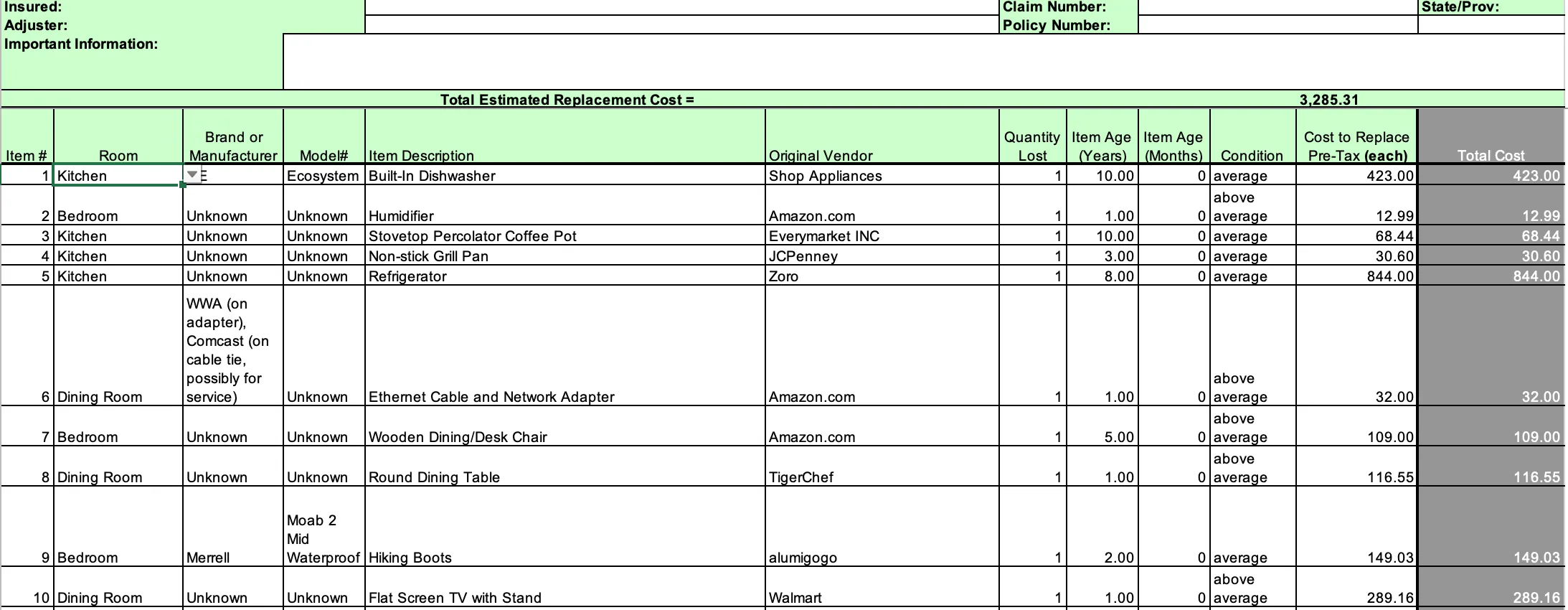
Section titled “What’s Included”The Standard Format Spreadsheet exports your inventory into a fixed spreadsheet layout designed for import into estimation and claims software. By default it uses the XactContents layout, with columns such as:
-
Item # - Sequential item number
-
Room - Location within the property
-
Brand - Item brand/manufacturer
-
Model # - Model number or identifier
-
Description - Item name and details
-
Original Vendor - Source or supplier information
-
Quantity Lost - Number of items
-
Item age (year) - Age in years
-
Item age (month) - Age in months
-
Condition - Item condition rating
-
Cost to replace - Replacement cost per item (pre-tax)
-
Total cost - Total replacement cost (quantity × cost)
The XactContents layout also includes three hidden columns used when the file is imported into XactContents: CAT and SEL (the item’s Xactimate replacement category and selector codes) and Link (the replacement product’s web link). They don’t appear on screen, but you can unhide them in Excel if you want to review the codes.
If you choose a carrier-specific format (see Output Format below), the columns and layout match that carrier’s own spreadsheet instead — so the file imports cleanly into their system.
Available as: Spreadsheet (XLSX) only (designed for data import into other systems)
Output Format
Section titled “Output Format”Default: XactContents (from XactContents Spreadsheet); the job’s carrier, when recognized (from Total Loss Carrier Spreadsheet)
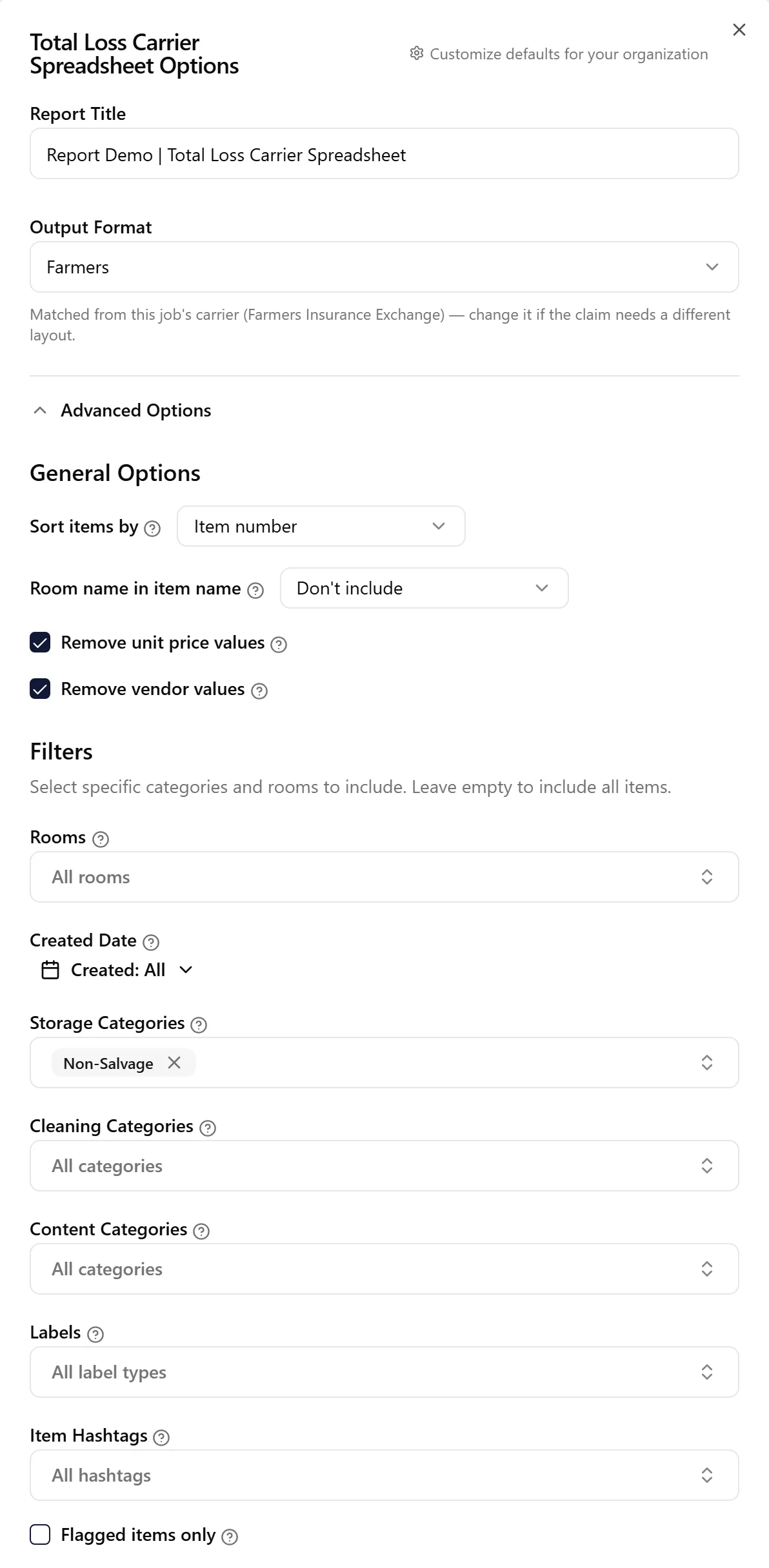
The main choice for this report: which spreadsheet layout to export. XactContents is the standard, industry-compatible layout. You can also pick a carrier-specific format — such as AAA, Allstate, Encompass, Esurance, Farm Bureau, Farmers, Homesite, MEEMIC, Openly, Pioneer, State Farm, or USAA — to match that carrier’s required import template. The available columns are determined by the format you select.
When you start from Total Loss Carrier Spreadsheet, ContentsPal preselects the layout that matches the insurance company on the job and shows which carrier it matched — change it if the claim needs a different layout. If no carrier matches, pick one before generating.
If your organization has added its own carrier spreadsheets, they appear under Organization Templates at the top of the dropdown, above the built-in Carrier Templates. Owners and admins can add them under Organization → Settings → Reporting → Export Templates.
When to Use This Report
Section titled “When to Use This Report”Best for:
-
Exporting to Xactimate or XactContents
-
Importing into claims management systems
-
Sharing with adjusters who use industry-standard software
-
Maintaining compatibility with estimation tools
Not ideal for:
-
Custom column layouts (use Custom Inventory Report)
-
Visual documentation (use Photo Report)
-
Quick readability (use PDF reports)
How to Generate
Section titled “How to Generate”-
Open your job in the web app
-
Click the Reports tab (top right)
-
Click Generate Report
-
Select Total Loss Carrier Spreadsheet from the list — or expand Additional Reports and select XactContents Spreadsheet
-
Choose an Output Format — XactContents or a specific carrier
-
(Optional) Adjust the remaining options under Advanced Options (see below)
-
Click Generate Report
Note: Most reports download immediately. Large jobs (2000+ items) are emailed to you when ready.
Customization Options
Section titled “Customization Options”Remove Unit Price Values
Section titled “Remove Unit Price Values”Default: Enabled
When enabled, clears the per-item replacement cost from the export (the column stays in the layout but is left blank). Turn it off to include pricing. Useful when sharing with external parties who don’t need pricing information.
Remove Vendor Values
Section titled “Remove Vendor Values”Default: Enabled
When enabled, clears the vendor / place-of-purchase information from the export, including the hidden Link column. Turn it off to include vendor details.
Sort Items By
Section titled “Sort Items By”Default: Item number
Sets the order of the rows in the spreadsheet: by Item number, or grouped by Room name (A–Z).
Room Name in Item Name
Section titled “Room Name in Item Name”Default: Don’t include
A few carrier formats — currently Farmers and Farm Bureau, plus any organization template with no room column — have no room column of their own, so the room each item came from would be missing from the export. For those formats you can add the room name to the item name instead, either before it (Living Room - Sofa) or after it (Sofa - Living Room).
This option only appears when the selected Output Format has no room column. Items with no room assigned keep their name unchanged.
Item Filters
Section titled “Item Filters”Default: Storage Categories set to Non-Salvage (all non-salvageable items included)
Use filters to include only specific items in the spreadsheet. The Storage Categories filter starts on Non-Salvage — clear it to include items from every storage category.
Available filters:
-
Rooms: Filter by specific rooms. Select “No Room” to include unassigned items
-
Created Date: Include only items created within a date range
-
Storage Categories: Filter by where items are stored (Storage, Left On Site, Third Party, Non-Salvage, Other)
-
Cleaning Categories: Filter by cleaning requirements (Needs Cleaning, Biohazard, As Is, etc.)
-
Content Categories: Filter by content type (e.g., Electronics, Kitchenware)
-
Labels: Filter by label type (Box, Tag, Textile, Garment Bag, Non-Salvageable, Other, or No Label)
-
Item Hashtags: Include only items with specific hashtags
-
Flagged items only: Include only items flagged for review
When you select multiple options in a filter, the spreadsheet includes items matching any of those selections.
Important Notes About This Format
Section titled “Important Notes About This Format”Fixed Column Structure
Section titled “Fixed Column Structure”Each template has a fixed column structure required for compatibility with its target software. You choose the template, but you cannot customize which columns appear. (Owners and admins can change what goes into each column of an organization template by editing its mapping — but not add or remove the carrier’s own columns.)
If you need custom columns, use the Custom Inventory Report instead.
No Photos
Section titled “No Photos”This spreadsheet does not include item photos. It’s designed for data transfer, not visual documentation.
For photo documentation, use the Photo Report instead.
Pricing Information
Section titled “Pricing Information”This format can include replacement cost information that may not be appropriate to share with all parties. The “Remove Unit Price Values” option is on by default to exclude pricing — turn it off when you want prices in the export.
Viewing Report History
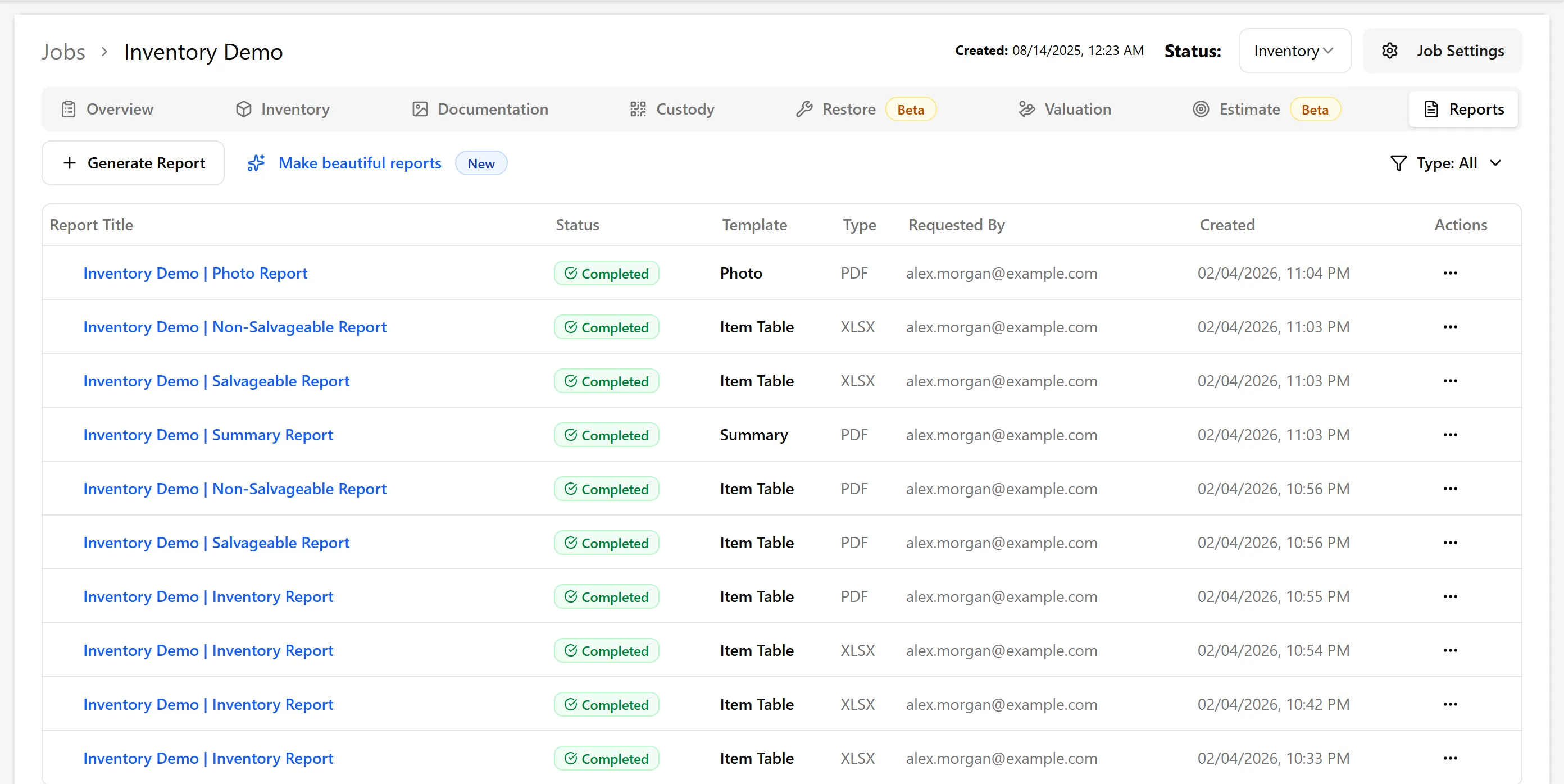
Section titled “Viewing Report History”All generated spreadsheets are stored in the Reports tab where you can:
-
Download again anytime
-
See when the report was generated
-
View who requested it
-
Keep pricing removed (the default) before sharing with policyholders or external contractors
-
Pick the matching carrier template when sending to a specific carrier so the file imports without reformatting
-
Use filters to create exports for specific rooms or categories
-
Test import first with a small subset of items to ensure proper formatting
Troubleshooting
Section titled “Troubleshooting”Spreadsheet missing expected data
-
Check if filters are enabled and excluding items
-
Verify items have all required fields populated
-
Try generating without filters to see all items
File won’t open
-
Ensure you have Excel or compatible spreadsheet software
-
Try opening in Google Sheets if Excel is unavailable
-
Re-download if the file appears corrupted
Related Articles
Section titled “Related Articles”-
Export Templates - Adding your own carrier spreadsheets
-
Custom Inventory Report - Flexible column layouts
-
Salvageable Report - Detailed salvageable item lists
-
Replacements Report - Replacement pricing details